Friday, December 31, 2010

The lighthouse keeper's New Year's Eve

The twin lights of Thacher Island
On New Year’s Eve, 1921, William Daggett, an assistant keeper at the Thacher Island Twin Lights off Rockport, Massachuetts, discovered that several geese had flown right into the lantern of the north tower, shattering two thick panes of glass. 

Three geese were found dead inside the lantern, and two more were discovered at the base of the tower the following morning. Needless to say, the families had goose for New Year’s dinner that year.

Happy New Year! 

Wednesday, December 29, 2010

The Hurricane of '38 at Dumpling Rock

Dumpling Rock Light (U.S. Coast Guard photo)
Octave Ponsart became keeper at Dumpling Rock Lighthouse, off Dartmouth, Massachusetts, in 1937, after working as an assistant at Great Point Light on Nantucket. Ponsart’s daughter, Seamond Ponsart Roberts, was born in 1940, while her parents lived on Dumpling Rock.  

The worst hurricane in recorded New England history slammed into the south-facing coast on September 21, 1938. Roberts tells the story of the storm’s devastating impact on Dumpling Rock, as told to her by her parents:


On that gray Wednesday, September 21, 1938, my parents, my sister Bette and my cousin were scheduled to leave the Rock for a long-awaited vacation. It was to be their first vacation since the Depression. 

Octave Ponsart
Assistant Keeper Henry Fontenot’s wife, May, helped Mom to pack and supplied gentle chatter as they were about to row ashore. They had the suitcases in the dory, ready to go, when the wind suddenly rose and the water got really rough. The storm came on quickly. “Just like that!” they would later say with a snap of the fingers.

Dad was not about to launch the dory in that kind of weather. He headed Mom, my sister Bette, and cousin Connie back to the house. Dad and Henry tried to secure the dory, but their efforts were fruitless and the boat was swept seaward. They headed for the oil house and the light tower to secure what they could. 

The task of securing anything soon became impossible. Dad and Henry headed for the keeper’s house as waves began to wash the rocks, flooding the first floor. My father hung onto a doorknob on the front door as he hollered to my mother, sister, and cousin to get upstairs and go to the assistant keeper’s rooms on the lee side of the building. The dog, Rexena, was swimming in the living room. 

Henry pointed seaward, and all he and Dad could see was foggy foam and mountainous combers heading directly for their rocky island. From what they could see, the waves were getting progressively larger. Dad said that even the first ones coming in looked like they would engulf the tower. At that point, they were both sure they would not survive.

Henry said, “Octave, I think we’re going to lose the light.” Dad nodded and they headed upstairs to be with the women and children. There was nowhere else to go. My father had been on lightships, and he said he had never seen such a “quick sea” develop. In quick succession many waves hit, breaking completely over the house and lighthouse.

The keepers had been doing carpentry in one of the bedrooms and had nails and boards ready. They nailed boards over the windows and braced the floors with the biggest spikes they had in the toolbox. The window glass was quickly broken and the whole house was wet inside. Outside, boards were being torn from their nails and the screeching noise was terrible.

Pieces of the roof tore off. The house shuddered with each wave, and the side facing the sea caved in and was leaning. Henry and May talked of lashing themselves to a mattress to try to make it to Round Hill. Dad argued they would never last.

May Fontenot was crying. She told my mother, “I think we are all going to die, but at least I know we have been such good friends. I’m so glad you’re here with me.” My mother cried too, because May was such a sweet person. Mom would tell me this story later and she’d always cry, saying, “That May, she was one of the best friends I ever had.” And she’d add, “We really thought we were going to die. In a few minutes, even.”

My mother, sister, and cousin were in shock, huddled on the bed, wrapped in sheets. My cousin had a massive nosebleed, apparently from fear, and Dad tried to help her. Then there was a noise “like a freight train or what an earthquake must sound like,” as Mom described it. Then came a tremendous long-lasting blast of water and a huge pounding shock with a splintering of wood. Those on the bed were hurled to the floor.

Henry and Dad knew something even more drastic had happened. The water on the first floor was now almost up to the ceiling. They opened the bedroom door and peered around the whirling water to see a bit of sky through the side of the living room and a massive obstruction where just before the ceiling and walls had been.

A huge piece of rock had been torn free by the hurricane waves, lifted up and hurled through the side of the first floor living room. Now it sat there, actually anchoring the house and lighthouse to Dumpling Rock.The rock had opened up a channel through the house, easing the flow of water entering and exiting the building now without too much of an obstruction. Henry and Dad turned back to report this, and May cried and cried.
Seamond at Cuttyhunk

Blow after blow came after that and yet the rock in the living room  held firm. Mom said later when she sang the hymn, Rock of Ages, Cleft for Me, it had a new and much more personal meaning.The six remained upstairs through the dreadful night. When morning came and the waters had receded, they ventured downstairs.

Nothing was left. Nothing except Rexena, who had spent the storm in the linen closet, going to the top shelf as the water rose. This was proven by the dog’s footprints that had been left on each shelf.

The waters that swirled around Dumpling Rock were filled with debris, telephone poles, and pieces of homes and trees. There was seaweed on top of the light tower. The keeper’s quarters were in shambles. There were no clothes or furnishings or anything else left except a few canned goods still in a closet. A pile of canned goods was found a few weeks later, wedged between the rocks below the tide line, as well as one silver spoon inherited from a Cornell grandmother. On shore, Dad’s new car, which had been parked at the boat launch at Round Hill, was gone, probably washed into Buzzards Bay.


Roberts “learned to walk,” she says, “on the very rocks that were nearly a death trap for my parents and my sister in the 1938 hurricane.”

Tuesday, December 28, 2010

A close call at White Island, NH

White Island Lighthouse is on the southernmost of the Isles of Shoals, a barren but fascinating group of islands several miles off the coast of New Hampshire and southern Maine. In the Coast Guard era at White Island, three men were assigned to the station; generally, there were two on duty at a time. I received the following story from Rev. Harold Roberts a couple of years ago. He was one of the Coast Guard keepers 1956-58. I never posted this online until now.

During the winter of 1956, we were experiencing one of those rare days at the Isles of Shoals when the sun was shining and the sea was placid, but it was still bitter cold. I decided to take the small double ended peapod dinghy we used to get on and off the island and row around to the back of the island get close to the seals that often lay on the rocks sunning themselves on such days. This day there was a larger number of seals lying on the rocks and I hoped I could get close to them with arousing them.


As I rowed around the back side of the island about 200 yards out I suddenly heard a roaring noise to my right. A huge wave, a groundswell about 20 feet high, was coming right at me. I swung the bow of the boat into the wave but not fast enough to prevent the boat from being overturned and me being dumped into the ocean.

The water was bitter cold and I was clothed with heavy foul weather gear including heavy robber boots. The weight of my boots filling with water pulled me down and prevented me from using my legs to kick myself to the surface. Judging from the pressure in my ears I must have sank at least 15 feet before I started slowly rising to the surface. 


The air trapped in my jacket saved me from being pulled down to the bottom. As soon as I broke surface I started to sink again.  My hands were so frozen I could not unclasp the boots that were preventing me from swimming. I knew I was in grave danger of drowning. In desperation and fear called out to God to save me. 

Coast Guard crew at White Island, late 1980s
A moment later, the capsized dingy suddenly appeared right next to me. I was able to hold on to the boat to stay afloat. My next and most immediate problem was the cold. I was freezing to death. I was aware that a man can't stay alive very long exposed to those conditions. The other problem was I was several hundred yards off the island and no one knew I was in trouble. Charlie Martin and I were alone on the island and he was unaware of my predicament.

I must have fallen asleep from the cold and was not aware that the boat with me clinging half conscious to the side had drifted to the island and a gentle swell pushed us into the rocks. I had enough strength to climb up out of the water and make my way to the keeper’s house. Charlie Martin was in the kitchen when I came in the door. I must looked frozen which I was. Charlie got blankets for me to help me recover my body heat.

To this day I believe it was divine intervention that saved my life on that bitter cold winter day on the Isles of Shoals.

Monday, December 27, 2010

More high seas in the wake of Blizzard 2010

The much ballyhooed Blizzard of 2010 wasn't what it was cracked up to be here on the New Hampshire Seacoast -- we got maybe 8-10" of snow instead of the 18-24" that was predicted. (I'm not complaining!) It was worse down on Boston's South Shore, with upwards of 16" of snow and much coastal flooding.

Arthur Richmond, author of the book Cape Cod Lighthouses and Lightships, sent me the spectacular photos below. Thanks to Art for the nifty images!

Minot's Ledge Lighthouse, off Scituate and Cohasset, Massachusetts
Photo by Arthur Richmond, used with permission

Scituate Lighthouse, Massachusetts
Photo by Arthur Richmond, used with permission 

Stormy surf at Whaleback Ledge


Whaleback Lighthouse, in the mouth of the Pistacaqua River a short distance from the shores of Kittery, Maine, is a classic granite wave-swept tower, built in 1872. I drove to Great Island Common in New Castle, New Hampshire, earlier today, hoping to catch some mammoth waves hitting Whaleback near high tide in the wake of the blizzard that just passed to the north. It was a little disappointing -- I've seen much higher waves in past storms. Still, the seas were seriously churned up, as you can see here.


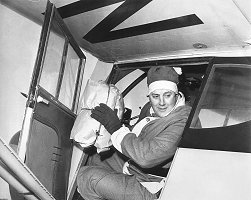
Another successful year for the Flying Santa

Edward Rowe Snow
The Flying Santa to New England's Coast Guard stations and lighthouses has successfully completed the 2010 flights -- the latest in a tradition that dates back to 1929. Maine pilot Bill Wincapaw started the flights as a way to say "thank you" to lighthouse keepers and their families, and the popular historian Edward Rowe Snow became involved in the mid-1930s and kept the tradition going through 1980.

Today, the nonprofit organization Friends of Flying Santa runs the program with visits to more than 30 Coast Guard and civilian locations in the Northeast. The tradition continues primarily as a way to say thanks to the Coast Guard families who do so much all year.

Santa at Coast Guard Station Portsmouth Harbor, NH
Much of the expense of the flights is donated, but it still costs a good amount to keep the tradition going every year. Your donation of any size to Friends of Flying Santa is greatly appreciated by those who run the program and those who benefit from it.

Tuesday, December 21, 2010

Christmas Eve at Portland Head Light, 1886: "Even Santa Claus Was Afraid to be Out"

The wreck of the Annie C. Maguire ranks among the most famous Maine shipwrecks for one reason. It occurred right next to one of the most popular lighthouses on the East Coast, Portland Head Light in Cape Elizabeth, Maine.

The ship we know as the Annie C. Maguire led two lives. The first incarnation was the extreme clipper ship Golden State, built on the East River in New York City in 1852-53. In early 1883, after an unusually long 30-year career in the China trade, the Golden State was converted to bark rigging.

Renamed the Annie C. Maguire, the bark sailed under the British flag in North and South America during the 1883-86 period. The Maguire was headed home to Quebec in December 1886, after leaving Buenos Aires, Argentina. On board with Captain Daniel O’Niel were his wife and 12-year-old son, two mates, and 13 crewmen.

The Maguire entered Casco Bay at about 11:00 p.m. on Christmas Eve, with the intention of riding out the bad weather in Portland Harbor.A heavy sea was visible outside Portland Harbor that day, as a winter storm was raging offshore. At Portland Head Lighthouse in Cape Elizabeth, a few miles from the harbor’s entrance, Keeper Joshua Freeman Strout was asked by a sheriff’s officer to keep an eye out for the ship, in case the captain decided to duck into Portland Harbor to take shelter from the storm.

Joshua Strout, courtesy of the Museum at Portland Head
Joshua Strout was a former sea captain who had become a lighthouse keeper at Portland Head in 1869 after a fall from a masthead forced him to give up life at sea. Joshua and his wife, Mary (Berry), raised 11 children at the station. Mary Strout served as an assistant keeper until 1877, when her son Joseph Woodbury Strout was named assistant.  Joseph Strout went on to succeed his father as principal keeper in 1904, and he retired in 1928 after living for 59 years at Portland Head.

Joseph Strout was described as “a “bronzed, hardy little man, comfortably inclined to corpulence” in a 1927 article, in which he recalled the night the Annie C. Maguire was wrecked. Some accounts of the event claim the weather was clear, but Joseph Strout firmly stated otherwise: “The wind was howling a gale,” he said. “It was Christmas Eve, you know, and I guess even Santa Claus was afraid to be out."

Strangely, in an interview in 1929, Joseph Strout said it was snowing so hard “you couldn’t see a hand in front of you,” but that the night was calm and there was no wind. He said his father was on watch in the lighthouse and the “world as silent as death.” Windy or not, in both interviews Strout stressed the fact that it was snowing heavily.

At about 11:30 p.m., as Joshua Strout kept watch in the lighthouse tower, Joseph was preparing for bed. Suddenly, Joshua burst through the door of the keeper’s house and exclaimed, “All hands turn out! There’s a ship ashore in the dooryard!” Joseph fumbled as he put his socks and shoes back on, and then bolted down the stairs a half-dozen at a time.

Joseph Strout, courtesy of the Museum at Portland Head
When he emerged from the house, Joseph Strout was amazed to see the ship on the ledges no more than 100 feet from the lighthouse tower, listing to one side. As soon as it had run onto the ledge, the captain had the crew take down the sails and lower the anchors. According to some accounts, Mary Strout shed light on the scene by burning blankets that had been cut into strips and soaked in kerosene.

There are varying versions of how the Strouts rescued the people from the ship. In 1927, Joseph Strout said that the water was calm enough to permit the men “to jump ashore, almost without help, so hard on the ledge was the vessel.”Some have claimed the Strouts rescued everyone with a breeches buoy. Other sources claim the Strouts put a ladder across the ship, and all aboard made it safely across the ladder to solid ground, which seems more likely. It was too short a distance to warrant a line from the shore to the ship, and there would have been a rush to get everyone off as quickly as possible in case the Maguire broke apart.

Mary Strout soon had hot coffee and food ready for the shipwreck victims in an engine room. They were ravenous after their long voyage with little more to eat than salt beef and macaroni. Joseph Strout said in 1929:

The day before we had killed eight chickens so that we could have a big feed on Christmas. Ma made all eight into the best pie you ever tasted. But it didn’t make no impression on that crew of three-quarter starved blotters though. I only got one plateful. But we should worry. A feller doesn’t get wrecked often, and when it happens where he can eat after starving for weeks, you can’t blame him for passing his plate until it’s all gone. Once they got that chicken pie into them, the whole gang wanted to stay. They loafed around three days and ate most of the food we had while Dad did his best to convince them that we were a lighthouse and not a life saving station.

Joshua Strout was put in charge of the ship by the deputy sheriff, and the wreck was soon surveyed. The New York Times reported on December 27 that the Maguire’s bottom was “badly stove.” It was thought that the ship would likely break apart in the next storm, so Joshua Strout ordered that everything removable be brought ashore as quickly as possible. The Maguire broke apart in a storm about a week after the wreck.

Joseph Strout’s son, John A. Strout, was born at the lighthouse in 1891. He followed the family tradition by becoming an assistant keeper under his father, on his twenty-first birthday. On the same day, John A. Strout painted an inscription on the ledge where the Maguire was wrecked. He first had to chip much of the huge rock to make a flat surface on which to paint, and the lettering was applied with a mixture of paint, mortar, and sand.

The exact wording and spelling of the inscription have varied over the years and a wooden cross that once topped the rock is gone, but the tradition of repainting it continues as a reminder of the Christmas Eve when a once proud ship almost hit the lighthouse.

This is a shortened version of a chapter from my book, Great Shipwrecks of the Maine Coast, published in 2010 by Commonwealth Editions.