Monday, December 27, 2010

More high seas in the wake of Blizzard 2010

The much ballyhooed Blizzard of 2010 wasn't what it was cracked up to be here on the New Hampshire Seacoast -- we got maybe 8-10" of snow instead of the 18-24" that was predicted. (I'm not complaining!) It was worse down on Boston's South Shore, with upwards of 16" of snow and much coastal flooding.

Arthur Richmond, author of the book Cape Cod Lighthouses and Lightships, sent me the spectacular photos below. Thanks to Art for the nifty images!

Minot's Ledge Lighthouse, off Scituate and Cohasset, Massachusetts
Photo by Arthur Richmond, used with permission

Scituate Lighthouse, Massachusetts
Photo by Arthur Richmond, used with permission 

Stormy surf at Whaleback Ledge


Whaleback Lighthouse, in the mouth of the Pistacaqua River a short distance from the shores of Kittery, Maine, is a classic granite wave-swept tower, built in 1872. I drove to Great Island Common in New Castle, New Hampshire, earlier today, hoping to catch some mammoth waves hitting Whaleback near high tide in the wake of the blizzard that just passed to the north. It was a little disappointing -- I've seen much higher waves in past storms. Still, the seas were seriously churned up, as you can see here.


Another successful year for the Flying Santa

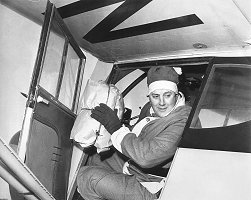
Edward Rowe Snow
The Flying Santa to New England's Coast Guard stations and lighthouses has successfully completed the 2010 flights -- the latest in a tradition that dates back to 1929. Maine pilot Bill Wincapaw started the flights as a way to say "thank you" to lighthouse keepers and their families, and the popular historian Edward Rowe Snow became involved in the mid-1930s and kept the tradition going through 1980.

Today, the nonprofit organization Friends of Flying Santa runs the program with visits to more than 30 Coast Guard and civilian locations in the Northeast. The tradition continues primarily as a way to say thanks to the Coast Guard families who do so much all year.

Santa at Coast Guard Station Portsmouth Harbor, NH
Much of the expense of the flights is donated, but it still costs a good amount to keep the tradition going every year. Your donation of any size to Friends of Flying Santa is greatly appreciated by those who run the program and those who benefit from it.

Tuesday, December 21, 2010

Christmas Eve at Portland Head Light, 1886: "Even Santa Claus Was Afraid to be Out"

The wreck of the Annie C. Maguire ranks among the most famous Maine shipwrecks for one reason. It occurred right next to one of the most popular lighthouses on the East Coast, Portland Head Light in Cape Elizabeth, Maine.

The ship we know as the Annie C. Maguire led two lives. The first incarnation was the extreme clipper ship Golden State, built on the East River in New York City in 1852-53. In early 1883, after an unusually long 30-year career in the China trade, the Golden State was converted to bark rigging.

Renamed the Annie C. Maguire, the bark sailed under the British flag in North and South America during the 1883-86 period. The Maguire was headed home to Quebec in December 1886, after leaving Buenos Aires, Argentina. On board with Captain Daniel O’Niel were his wife and 12-year-old son, two mates, and 13 crewmen.

The Maguire entered Casco Bay at about 11:00 p.m. on Christmas Eve, with the intention of riding out the bad weather in Portland Harbor.A heavy sea was visible outside Portland Harbor that day, as a winter storm was raging offshore. At Portland Head Lighthouse in Cape Elizabeth, a few miles from the harbor’s entrance, Keeper Joshua Freeman Strout was asked by a sheriff’s officer to keep an eye out for the ship, in case the captain decided to duck into Portland Harbor to take shelter from the storm.

Joshua Strout, courtesy of the Museum at Portland Head
Joshua Strout was a former sea captain who had become a lighthouse keeper at Portland Head in 1869 after a fall from a masthead forced him to give up life at sea. Joshua and his wife, Mary (Berry), raised 11 children at the station. Mary Strout served as an assistant keeper until 1877, when her son Joseph Woodbury Strout was named assistant.  Joseph Strout went on to succeed his father as principal keeper in 1904, and he retired in 1928 after living for 59 years at Portland Head.

Joseph Strout was described as “a “bronzed, hardy little man, comfortably inclined to corpulence” in a 1927 article, in which he recalled the night the Annie C. Maguire was wrecked. Some accounts of the event claim the weather was clear, but Joseph Strout firmly stated otherwise: “The wind was howling a gale,” he said. “It was Christmas Eve, you know, and I guess even Santa Claus was afraid to be out."

Strangely, in an interview in 1929, Joseph Strout said it was snowing so hard “you couldn’t see a hand in front of you,” but that the night was calm and there was no wind. He said his father was on watch in the lighthouse and the “world as silent as death.” Windy or not, in both interviews Strout stressed the fact that it was snowing heavily.

At about 11:30 p.m., as Joshua Strout kept watch in the lighthouse tower, Joseph was preparing for bed. Suddenly, Joshua burst through the door of the keeper’s house and exclaimed, “All hands turn out! There’s a ship ashore in the dooryard!” Joseph fumbled as he put his socks and shoes back on, and then bolted down the stairs a half-dozen at a time.

Joseph Strout, courtesy of the Museum at Portland Head
When he emerged from the house, Joseph Strout was amazed to see the ship on the ledges no more than 100 feet from the lighthouse tower, listing to one side. As soon as it had run onto the ledge, the captain had the crew take down the sails and lower the anchors. According to some accounts, Mary Strout shed light on the scene by burning blankets that had been cut into strips and soaked in kerosene.

There are varying versions of how the Strouts rescued the people from the ship. In 1927, Joseph Strout said that the water was calm enough to permit the men “to jump ashore, almost without help, so hard on the ledge was the vessel.”Some have claimed the Strouts rescued everyone with a breeches buoy. Other sources claim the Strouts put a ladder across the ship, and all aboard made it safely across the ladder to solid ground, which seems more likely. It was too short a distance to warrant a line from the shore to the ship, and there would have been a rush to get everyone off as quickly as possible in case the Maguire broke apart.

Mary Strout soon had hot coffee and food ready for the shipwreck victims in an engine room. They were ravenous after their long voyage with little more to eat than salt beef and macaroni. Joseph Strout said in 1929:

The day before we had killed eight chickens so that we could have a big feed on Christmas. Ma made all eight into the best pie you ever tasted. But it didn’t make no impression on that crew of three-quarter starved blotters though. I only got one plateful. But we should worry. A feller doesn’t get wrecked often, and when it happens where he can eat after starving for weeks, you can’t blame him for passing his plate until it’s all gone. Once they got that chicken pie into them, the whole gang wanted to stay. They loafed around three days and ate most of the food we had while Dad did his best to convince them that we were a lighthouse and not a life saving station.

Joshua Strout was put in charge of the ship by the deputy sheriff, and the wreck was soon surveyed. The New York Times reported on December 27 that the Maguire’s bottom was “badly stove.” It was thought that the ship would likely break apart in the next storm, so Joshua Strout ordered that everything removable be brought ashore as quickly as possible. The Maguire broke apart in a storm about a week after the wreck.

Joseph Strout’s son, John A. Strout, was born at the lighthouse in 1891. He followed the family tradition by becoming an assistant keeper under his father, on his twenty-first birthday. On the same day, John A. Strout painted an inscription on the ledge where the Maguire was wrecked. He first had to chip much of the huge rock to make a flat surface on which to paint, and the lettering was applied with a mixture of paint, mortar, and sand.

The exact wording and spelling of the inscription have varied over the years and a wooden cross that once topped the rock is gone, but the tradition of repainting it continues as a reminder of the Christmas Eve when a once proud ship almost hit the lighthouse.

This is a shortened version of a chapter from my book, Great Shipwrecks of the Maine Coast, published in 2010 by Commonwealth Editions.

Destaffing of Canadian lighthouses on hold

Machias Seal Island Light Station, New Brunswick, still has resident keepers.
Every lighthouse in the United States is now automated, as are most lighthouses around the world. Along with automation, most light stations have had their keepers removed. In the U.S., there's only one resident keeper still employed by the government, at Boston Light.

The Canadian government has kept about 50 stations staffed, on both the east and west coasts of the country. Most are in British Columbia and in Newfoundland and Labrador.

The Canadian Coast Guard had been working toward the destaffing of these stations, but a senate committee has now recommended that the keepers be kept in place.

"A lightstation-by-lightstation approach to reviewing staffing requires appropriate guidelines and thorough consultations," Senator Dennis Patterson said in a statement. "The views of lightkeepers, user groups, coastal communities and other interested parties, both in the local areas and elsewhere need to be taken into account."

Click here to read more about this story.

You can also read the full senate report (PDF file) by clicking here.

Saturday, December 18, 2010

A Great Day for the Flying Santa

Santa with children of Coast Guard families at Station Portsmouth Harbor


New England's Flying Santa is an 81-year-old tradition that began as a way to honor lighthouse keepers and lifesavers in remote coastal locations, and it continues today as a fun way of saying thank you to Coast Guard personnel and their families.

The first Flying Santa was Maine pilot Bill Wincapaw, who started flying float planes over Maine's light stations on Christmas 1929. Wincapaw dropped packages containing magazines, toiletries, toys, and other items for the keepers and their families as a show of gratitude for their devotion to safe navigation. Massachusetts historian Edward Rowe Snow became involved with the flights in the 1930s and took them over in the 1940s. Snow continued as the Flying Santa through 1980. The following year, the flights were picked up by the Hull Lifesaving Museum, near Boston, with Ed McCabe playing Santa.

The museum kept the tradition going until a separate nonprofit organization, the Friends of Flying Santa, was founded. Brian Tague, a photographer living in Stoneham, Massachusetts, became involved around 1990. He eventually became president of Friends of Flying Santa, and it's his work that has made it possible for the annual flights to continue well into the 21st century. Presents are no longer dropped; today a helicopter lands at Coast Guard stations from Connecticut to northern Maine, and presents are given to the children of Coast Guard families.

This year, the Flying Santa visited 33 Coast Guard stations and lighthouses. The costs of the helicopters and pilots were all donated. At the final stop of today's Maine/New Hampshire flight, Coast Guard Station Portsmouth Harbor in New Castle, New Hampshire, an award was presented to Brian Tague for his 20 years of dedication to this wonderful tradition. Below are some photos from the event.

Waiting for Santa

About to land
L to R: Brian Tague of Friends of Flying Santa, Santa Claus, and Senior Chief John Roberts of Station Portsmouth Harbor
Capt. James McPherson, the Coast Guard's commander in northern New England, presented Brian Tague with an award

"He (Brian Tague) and his staff of volunteers really go to great lengths to add a very special touch for our Coast Guard families in New England during the holiday season," Capt. McPherson said.
Brian Tague called it an honor to be involved with the Flying Santa tradition, and he thanked everyone involved with the flights

Everyone gathered inside the mess at the Coast Guard station and the children waited eagerly for their gifts
Another happy customer
Some of the personnel of Coast Guard Station Portsmouth Harbor posed with Santa
 

This video clip shows Santa's copter leaving the station and passing Portsmouth Harbor Lighthouse

For more on the Flying Santa, visit www.FlyingSanta.org

Thursday, December 16, 2010

Cleveland Ledge Light sells for $190,000

The federal government's auction of Cleveland Ledge Lighthouse in Buzzards Bay, Massachusetts, has ended, with someone using the name "hadley" coming out on top with a high bid of $190,000.

Here's a video that was posted back when the lighthouse first became available through the National Historic Lighthouse Preservation Act:


This lighthouse is unique -- the only Art Moderne-style lighthouse in the Northeast. I'm hoping that the new owner will consider providing some degree of public access, if it can be safely achieved. Even one open house per year would make us lighthouse buffs happy.