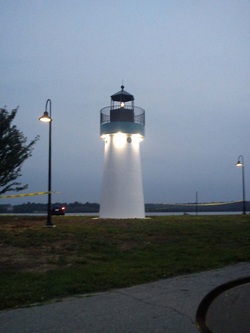
I'm stepping outside New England for this post. A new lighthouse has been erected in Metropolis, Illinois, on the edge of the Ohio River. The purpose of this beacon is not to guide shipping on the river; it has been erected to serve as a beacon of hope to individuals and families affected by cancer.
Rudy and Beverly Bess established the Hope Light Project in July 2005 to increase cancer awareness to enable people to recognize cancer signs and symptoms, detect cancer early, take immediate action to get help and save lives.
On the morning of July 4, 2005, Rudy and Beverly learned that a family member and also a good friend died from cancer within 15 minutes of each other. This devastating news drove the couple to establish a foundation to help others learn more about how to detect, fight, and survive cancer.
The Hope Light Foundation believes that the fight against cancer begins with knowledge. With this knowledge comes empowerment to make informed decisions on personal health matters and cancer treatment options. With empowerment comes strength that builds Hope; Hope for tomorrow, Hope for survivorship, and Hope for a cure.
"Hope Light" was lit last week. The beacon is an ML-155 marine lantern with five-mile visibility. The light stands 30 foot tall. The project still has some work remaining, including the construction of concrete walkways and the laying of personalized paver bricks.
To learn more about the Hope Light Project and how you can donate, visit www.hopelightproject.com

Monday, June 9, 2014
Wednesday, May 14, 2014
Fog Signal Building at Beavertail to get Facelift
From the spring newsletter of the Beavertail Lighthouse Museum Association in Jamestown, Rhode Island:
This past fall BLMA was awarded a $12,975 grant from the Champlin Foundations to undertake major restoration of the 1938/1939 historic Fog Signal Building. Work will be started shortly, but the grant requires our organization to match the funded amount.
The building was abandoned by the Coast Guard in 1971 when both the light and the fog signal were automated. The building has since been used as a aquarium and DEM Naturalist Center and has been popular with young visitors, but deteriorated to an unsightly state.
![]() |
| The fog signal building is to the right of the lighthouse |
Restoration work will entail repair of cracked mortar , repair and replacement of the glass block windows and their metal frames. The exterior will be parge coated and the red metal roof repainted. Pending available funds we hope to replicate the twin fog signal horn, which protruded from the seaward facing south wall.
Please help us raise the matching funds. Your donation is tax deductible per IRS regulations.
Send to:
BLMA Fog Signal Fund
P.O. Box 83
Jamestown, RI
BLMA Fog Signal Fund
P.O. Box 83
Jamestown, RI
Tuesday, May 13, 2014
U.S. Coast Guard Press Release on Boston Light Repair Project
May 13, 2014
U.S. Coast Guard
Contact: 1st District Public Affairs
Email: D1publicaffairs@uscg.mil
Office: (617) 223-8515
|
COAST GUARD ANNOUNCES PLANS FOR BOSTON LIGHT TRICENTENNIAL
![]() |
| Photo by Jeremy D'Entremont |
BOSTON — The Coast Guard has announced plans for the 2016 tricentennial of Boston Light to include a $1.1 million project to repair and renovate structures at the landmark.
The project, outlined Saturday during a public presentation by lighthouse keeper Sally Snowman, is intended to preserve the structural integrity of the lighthouse tower and surrounding buildings and assists in preparing for the light station’s upcoming tricentennial celebrations in 2016.
The ongoing refurbishment plan includes an underground storage tank remediation, a new exterior coating to the lighthouse, new cedar roofs on all structures, new windows in the lighthouse keeper's quarters, and painting of all structures. A new sewage treatment plant and temporary roof repairs have already been completed.
The lighthouse projects and other tricentennial preparations have been organized through the Boston Light Tricentennial Planning Group which includes members from:
• U.S. Coast Guard
• National Park Service
• Boston Harbor Island Alliance
• Coast Guard Auxiliary
• Friends of Boston Harbor Islands
• City of Boston
• Boston Marine Society
• Hull Lifesaving Museum
The mission of this planning group is to honor the 300-year service and iconic value of Boston Light to the Coast Guard's maritime heritage through the organization, planning, funding, management and execution of all activities associated with the tricentennial celebration.
"Boston Light, America's first lighthouse, is an iconic symbol of our nation's rich maritime tradition," said Capt. John O'Connor, commanding officer of Coast Guard Sector Boston. "Boston Light's 300th anniversary in 2016 is an opportunity for us to celebrate the history of this national treasure and to highlight its contribution to the evolution of aids to navigation and the approximately 50,000 other lighthouses, buoys, beacons, and markers safely guide mariners throughout the country. Please follow us in the planning and join us in the celebration of Boston Light's tricentennial."
Boston Light was established on Sept. 14, 1716. It became a National Historic Landmark in 1964. In 1989, Congress decreed Boston Light be operated on a permanently manned basis. It remains the last U.S. Coast Guard-manned lighthouse in the country and is still a major aid to navigation at the entrance to Boston Harbor.
Due to the ongoing repairs, Boston Light will not be open for public tours during the summer of 2014.
The project, outlined Saturday during a public presentation by lighthouse keeper Sally Snowman, is intended to preserve the structural integrity of the lighthouse tower and surrounding buildings and assists in preparing for the light station’s upcoming tricentennial celebrations in 2016.
The ongoing refurbishment plan includes an underground storage tank remediation, a new exterior coating to the lighthouse, new cedar roofs on all structures, new windows in the lighthouse keeper's quarters, and painting of all structures. A new sewage treatment plant and temporary roof repairs have already been completed.
The lighthouse projects and other tricentennial preparations have been organized through the Boston Light Tricentennial Planning Group which includes members from:
• U.S. Coast Guard
• National Park Service
• Boston Harbor Island Alliance
• Coast Guard Auxiliary
• Friends of Boston Harbor Islands
• City of Boston
• Boston Marine Society
• Hull Lifesaving Museum
The mission of this planning group is to honor the 300-year service and iconic value of Boston Light to the Coast Guard's maritime heritage through the organization, planning, funding, management and execution of all activities associated with the tricentennial celebration.
"Boston Light, America's first lighthouse, is an iconic symbol of our nation's rich maritime tradition," said Capt. John O'Connor, commanding officer of Coast Guard Sector Boston. "Boston Light's 300th anniversary in 2016 is an opportunity for us to celebrate the history of this national treasure and to highlight its contribution to the evolution of aids to navigation and the approximately 50,000 other lighthouses, buoys, beacons, and markers safely guide mariners throughout the country. Please follow us in the planning and join us in the celebration of Boston Light's tricentennial."
Boston Light was established on Sept. 14, 1716. It became a National Historic Landmark in 1964. In 1989, Congress decreed Boston Light be operated on a permanently manned basis. It remains the last U.S. Coast Guard-manned lighthouse in the country and is still a major aid to navigation at the entrance to Boston Harbor.
Due to the ongoing repairs, Boston Light will not be open for public tours during the summer of 2014.
For more information on Boston Light and the tricentennial planning, visit www.bostonharborislands.org and Coast Guard Sector Boston Homeport. Media wishing to access the light may contact BostonLightTricentennial@uscg.mil.
Monday, March 24, 2014
Palmer's Island Lighthouse on New Bedford's city seal
The 1849 Palmer's Island Lighthouse appears on the city of seal of New Bedford, Massachusetts. The motto "Lucem Diffundo" means "I Diffuse Light" or "I Spread the Light." It has a triple meaning.
1) The lighthouse itself served to "spread the light."
2) New Bedford was a center of the whaling industry and provided the whale oil that fueled our lighthouses and other lights around the country for many years.
3) New Bedford's city fathers were predominately Quakers. The Quakers referred to themselves as "Children of the Light." Their mission was to spread the "Light of Christ" to the world.
Palmer's Island Lighthouse is owned by the City of New Bedford, and it was restored and relighted back in 1999. It's currently undergoing another refurbishing. At this writing, the lantern has been removed and is undergoing restoration on shore.
The plans also include repointing of the interior and exterior walls, repair and cleaning of the steel stairs, the installation of new windows and hatches, and the installation of new solar powered lighting apparatus.
Click here for more on the city seal.
Click here for more on Palmer's Island Light.
1) The lighthouse itself served to "spread the light."
2) New Bedford was a center of the whaling industry and provided the whale oil that fueled our lighthouses and other lights around the country for many years.
3) New Bedford's city fathers were predominately Quakers. The Quakers referred to themselves as "Children of the Light." Their mission was to spread the "Light of Christ" to the world.
Palmer's Island Lighthouse is owned by the City of New Bedford, and it was restored and relighted back in 1999. It's currently undergoing another refurbishing. At this writing, the lantern has been removed and is undergoing restoration on shore.
The plans also include repointing of the interior and exterior walls, repair and cleaning of the steel stairs, the installation of new windows and hatches, and the installation of new solar powered lighting apparatus.
Click here for more on the city seal.
Click here for more on Palmer's Island Light.
Monday, March 17, 2014
Save the Bay's Rhode Island Lighthouse Tours 2014
![]() |
| Pomham Rocks Light, East Providence |
This is a great way to get up close to the lighthouses and to learn about their history. Some of the trips include a stop at Rose Island Light in Newport.
Click here for the schedule and more information.
Tuesday, March 11, 2014
Saving Gay Head Lighthouse
The most endangered lighthouse in New England is Gay Head Light, perched precariously on colorful clay cliffs at the western end of Martha's Vineyard. The 1856 brick tower now stands only about 46 feet from the brink, and erosion of the bluff continues to progress at an alarming rate.
The Town of Aquinnah (formerly Gay Head) has submitted an application to take ownership of the lighthouse under the National Historic Lighthouse Preservation Act. A committee of the National Park Service will review the application. Meanwhile, a town committee is working with the Martha's Vineyard Museum and other concerned parties on the planned relocation of the lighthouse.
As part of the fundraising effort to move the lighthouse, Rosanne Cash will play a benefit concert on Martha's Vineyard this summer. Click here to read more about that.
The Save the Gay Head Lighthouse Committee needs your support to save this iconic lighthouse. Please consider a donation; every dollar helps. You can learn more on these sites:
Gay Head Lighthouse
Save the Gay Head Lighthouse Facebook page
History of Gay Head Lighthouse
The Town of Aquinnah (formerly Gay Head) has submitted an application to take ownership of the lighthouse under the National Historic Lighthouse Preservation Act. A committee of the National Park Service will review the application. Meanwhile, a town committee is working with the Martha's Vineyard Museum and other concerned parties on the planned relocation of the lighthouse.
As part of the fundraising effort to move the lighthouse, Rosanne Cash will play a benefit concert on Martha's Vineyard this summer. Click here to read more about that.
The Save the Gay Head Lighthouse Committee needs your support to save this iconic lighthouse. Please consider a donation; every dollar helps. You can learn more on these sites:
Gay Head Lighthouse
Save the Gay Head Lighthouse Facebook page
History of Gay Head Lighthouse
Thursday, March 6, 2014
Sperry Light, CT, 1899-1933

This is an early 1900s postcard of the Outer Breakwall Light in New Haven, Connecticut, better known as Sperry Light. It was built in 1899.
Travel to and from the lighthouse was often difficult, especially in the winter months. To ease the isolation of the keepers, for some years representatives of the Seamen's Bethel in New Haven made regular trips to the lighthouse to deliver newspapers and magazines.
One day in January 1907, Keeper Samuel Armour left the lighthouse to row ashore for supplies. As he prepared to head back to the station in the early evening, a storm was worsening and the seas were growing rough. A New Haven man suggested that Armour spend the night on shore, but he felt he needed to return because the assistant keeper was in the hospital. Armour set out in his 15-foot rowboat.
The captain of a British schooner later reported seeing the rowboat overturned near Southwest Ledge Lighthouse, but Armour was never seen again. By 1907, several cracks were found in the foundation and the lighthouse began to tilt.
The cracks were filled and the tower was righted and reinforced with iron straps, allowing the lighthouse to remain operational until 1933, when it was replaced by an automatic skeleton tower.
Subscribe to:
Comments (Atom)


