Friday, May 15, 2009

PizzaFest with Music by Shannachie: A Benefit for Whaleback Lighthouse


Saturday May 16, 2009, at 6:00 p.m.
Kittery Lions Club, 117 State Rd. (Route 1), Kittery, Maine


Join the Friends of Portsmouth Harbor Lighthouse for a unique and tasty event! Try the best offerings from pizza restaurants in the Portsmouth/Kittery area. More than a dozen restaurants will be taking part. Along with pizza, there will be salad, soft drinks, and cookies. There will also be a silent auction with great prizes, including tickets to the Ogunquit Playhouse and gift certificates to local restaurants.

Irish music by Shannachie will enliven the evening. Pat Heffernan (guitar, vocals, songwriter, shennanigans) and Patrick Keane (bass, banjo, vocals, and "ham") make up Shannachie. Since 1995, they've been having fun entertaining people with Irish pub singalong songs all over New England.

Proceeds benefit the restoration of Whaleback Lighthouse.

Tickets are $20 for adults, $15 for seniors (65 and over) and $10 for children (12 and under).

You can buy tickets online at www.portsmouthharborlighthouse/pizzafest.html, or you can send a check made out to: Whaleback Committee of FPHL, to: Friends of Portsmouth Harbor Lighthouse, P.O. Box 8232, Portsmouth, NH 03802-8232. Be sure to include your address.

Advance tickets are recommended. If space is still available, tickets will be available at the door.

Thursday, May 14, 2009

Maine Lighthouse Museum Looking for Support

The museum housing the nation's largest collection of Fresnel lenses and other important lighthouse artifacts may soon have to close its doors due to a lack of revenue. Click here for the story in "Village Soup."

The Maine Lighthouse Museum has its roots in the collection amassed by the late Coast Guard officer Ken Black, known far and wide as "Mr. Lighthouse." Many lighthouse buffs recall the humble Shore Village Museum in Rockland, tended lovingly by Black for years.

Lots of small private donations would be a shot in the arm for the museum, but what's needed even more is substantial corporate support. Everyone loves lighthouses, and it could be a huge PR coup for any Maine company that lends major support to the museum. Not that it has to be a Maine company -- the museum is really America's Lighthouse Museum.

Monday, May 11, 2009

Lighthouse of the Week: Newport Harbor Light, Rhode Island


This lighthouse is one of the easiest in Rhode Island to visit, as it's located on the grounds of Newport's Hyatt Regency Hotel. It's relatively small and unassuming, but it has a rich history.

The deep, protected harbor at Newport was the key to its development from the start. By the early 1820s, it became clear that a lighthouse was needed to help guide vessels into the harbor, and on March 23, 1823, Congress appropriated $2,500 for that purpose.

The original lighthouse exhibited a fixed white light, visible for 14 nautical miles. Keeper Samuel Watson first illuminated the multiple oil lamps in the lantern on January 1, 1824. The 20-foot octagonal freestone and brick tower was fraught with problems almost from the start.

According to a report by Lt. George M. Bache of the U.S. Navy in 1838, the tower was “in a very bad condition, owing to its faulty construction.” He also found much wrong with the six-room stone keeper’s dwelling, which he said was badly built.

A dangerous reef extended out from the northern end of the island, and vessels often went aground there. In the late 1830s a breakwater was constructed over the reef. It was planned at first that the lighthouse would be relocated to the end of the breakwater. Instead, a new 35-foot granite tower was erected on the breakwater. The Army Corps of Engineers completed the breakwater in 1842. The old lighthouse remained in use until December 18, 1842, when the new tower was lighted for the first time.

At first, the keepers continued to live in the original dwelling. The original lighthouse tower was relocated to Prudence Island in 1851 and remains in operation there today. It is the oldest surviving lighthouse in the state.

John Case spent a decade (1853–63) as keeper. The next man to take the position, John Heath, died on September 24, 1868, and his wife received the appointment to replace him. Mary Ann Heath remained keeper until 1873, when Henry Crawford succeeded her.

Having a comfortable two-story house attached to the tower certainly made life easier for the keepers and their families, but Mary Ann Heath must have had quite a scare when a tremendous storm on September 8, 1869, carried away about a third of the slate roof and damaged her boat, which parted its moorings.

In 1869, the Secretary of War authorized the U.S. Navy to take over Goat Island for a new Naval Torpedo Station. The station was an important center for experimentation with various torpedoes and mines, for training of personnel, and eventually for the manufacture of torpedoes. During World War II, the station became the largest employer in the state, with more than 12,600 employees. Eighty percent of the torpedoes used in the war were produced at Goat Island.

Charles Schoeneman would become such a fixture as keeper that locals often simply referred to the lighthouse as Schoeneman’s Light. Keeper Schoeneman spent a remarkable 39 years at the station. An article on the occasion of Schoeneman’s retirement recalled the famous Portland Gale (the steamship Portland sank during the storm, with the loss of about 200 lives) of November 26, 1898. The storm broke every window on the north side of the keeper’s house.

On November 9, 1921, the 155-foot submarine N-4 rammed the breakwater near the lighthouse, causing damage to the foundation of the keeper’s dwelling and signaling the end of the staffed light station on Goat Island. Schoeneman retired during the following year, and the keeper’s house was demolished. The light was electrified, and personnel from the torpedo station took over its operation. The light was automated in 1963.

The Coast Guard licensed the lighthouse to the American Lighthouse Foundation (ALF) in 2000. Newport Harbor Light, known to most locals as Goat Island Light or simply “the Green Light,” continues as an active aid to navigation, its fixed green light 33 feet above the water.

There's more on this page and in my book, "The Lighthouses of Rhode Island."

Latest list for NHLPA


Under the National Historic Lighthouse Act of 2000, each year several lighthouses are being transferred to suitable new owners. If no qualified organizations apply, the lighthouses are auctioned to the general public. The latest list includes three very historic lighthouses in the Northeast:

Robbins Reef Light in New Jersey, longtime home to heroic lighthouse keeper Kate Walker.

Saddleback Ledge Light in Maine, a rugged and remote lighthouse designed by famed architect Alexander Parris.

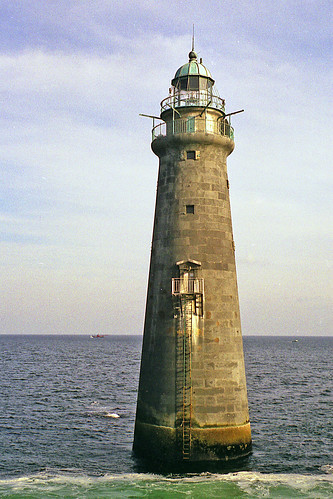
Minot's Ledge Light (left), off Boston's South Shore in Massachusetts, one of the greatest of all American lighthouse engineering achievements and one of the world's great wave-swept towers.

For the rest of the lighthouses on the list, check Sue Clark's "Lighthouse News" site.

Hopefully, some qualified nonprofit organization -- or maybe a partnership or coalition of multiple groups -- will be interested in Minot's Ledge Light. To me, it would be a crime to sell one of our most historic lighthouses to the high bidder.

Sunday, May 10, 2009

Wednesday, May 6, 2009

New Season for New England Lighthouse Tours


I'm now gearing up for a new season of New England Lighthouse Tours.

The tours are in a minivan, with no more than 5 passengers. My primary offering, a “Lighthouses of Portsmouth and Portland Tour,” includes the two lighthouses that are photographed more than any others in New England: Portland Head Light in Cape Elizabeth, Maine, and the Cape Neddick “Nubble” Light in York, Maine. At Portland Head, tour goers also explore the museum in the former keeper’s house.


The tours also include Spring Point Ledge Light and Portland Breakwater Light, both in South Portland, Maine, and Portsmouth Harbor Light in New Castle, New Hampshire. Participants get to climb to the top of Portsmouth Harbor Light to see the still-working nineteenth century lens up close, and to enjoy one of the most breathtaking views in the New Hampshire Seacoast region.

Lunch on the tours, included in the $99 per person ($59 for children) price, is at Joe’s Boathouse, located at the Spring Point Marina in South Portland. Also included is a shopping stop at Lighthouse Depot in Wells, Maine, renowned as “the world’s largest lighthouse gift store.” There are also smaller gift shops at Portland Head and Cape Neddick.

During the tours, I enjoy telling about the human history of the lighthouses and the keepers, but I try not to overwhelm people with endless facts and statistics. I find that the average person is most interested in what it was like for keepers and their families to live at these fascinating places.

While most of the people who have taken the tours so far have been from other parts of the country, I'm hoping this year’s tours might attract more local people. This is a great way to have a fun day out, visiting some of the most beautiful locations in the Northeast while letting someone else worry about the driving. A number of people have given my tours as birthday or anniversary presents, which I think is a wonderful idea.


The tours begin and end at the parking garage on Hanover Street in downtown Portsmouth. I've scheduled about 50 tour dates between late May and late October. You can read more at www.newenglandlighthousetours.com or you can call (603) 431-9155.

Monday, May 4, 2009

A Dive from Minot's Light


MNOT2, originally uploaded by nelights.

This clip shows Edward Rowe Snow (1902-1982), the popular New England maritime historian and "Flying Santa" to lighthouse keepers, diving from Minot's Ledge Lighthouse, off Boston's South Shore, in 1962. For more on the Flying Santa, see www.flyingsanta.org. For more on Minot's Ledge Lighthouse, see www.lighthouse.cc/minots/